
Latest news from DAWN

Congratulations to Lise Bech Christensen, who has just been awarded a “Research Project 1” grant of almost DKK 2,900,000, or roughly €390,000.
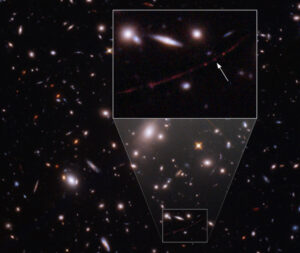
Through a fortuitous alignment of distant galaxy with a massive foreground cluster of galaxies, astronomers from among other institutes the cosmic Dawn Center discovered a single star across most of the entire observable Universe. This is the farthest detection of a single star ever. The star may be up to 500 times more massive than the Sun. The discovery has been published today in the scientific journal Nature.

Congratulations to DAWN fellow Seiji Fujimoto who has just received one of the most reputable research fellowship in astronomy, the NASA Hubble Fellowship.

Congratulations to Karina Caputi, who has just been awarded a “Vici grant” for senior researchers of 1.5 million euros.
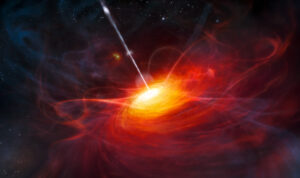
In the center of most galaxies lies a supermassive black hole. Some of these are actively feeding on the gas and dust around them, expelling excess energy as powerful jets that are seen as quasars across the entire observable Universe. A new study led by astronomers at the Cosmic Dawn Center reviewed this process using new techniques — and the results may change how we think about the diets of these cosmic behemoths.

The prize was awarded for Claudia Lagos’ insightful contributions to the research of gas in the evolution of galaxies, including its role in the chemical and angular momentum evolution of galaxies and in the promotion and suppression of the formation of stars.
The grant will be used to study the enigmatic fast radio bursts, for which Kasper Heintz recently was awarded 180 hours of observing time at the Very Large Telescope.
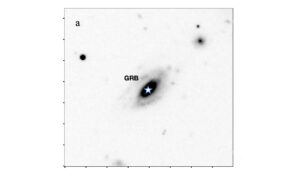
Combining observations of exploding stars and observations of galaxies, astronomers at the Cosmic Dawn Center have found a novel way to estimate the amount of the otherwise invisible, cold gas in some of the first galaxies — gas that will eventually condense and start forming stars.
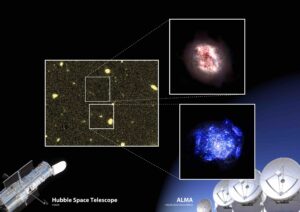
Astronomers from the Cosmic Dawn Center have discovered two previously invisible galaxies 29 billion light-years away. Their discovery suggests that up to one in five such distant galaxies remain hidden from our telescopes, camouflaged by cosmic dust.

Congratulations to Kate Whitaker, Pascal Oesch, Gabriel Brammer, and Fabian Walter for being among the top 1% highest cited researchers in the world.
